Introducing Nearshore.
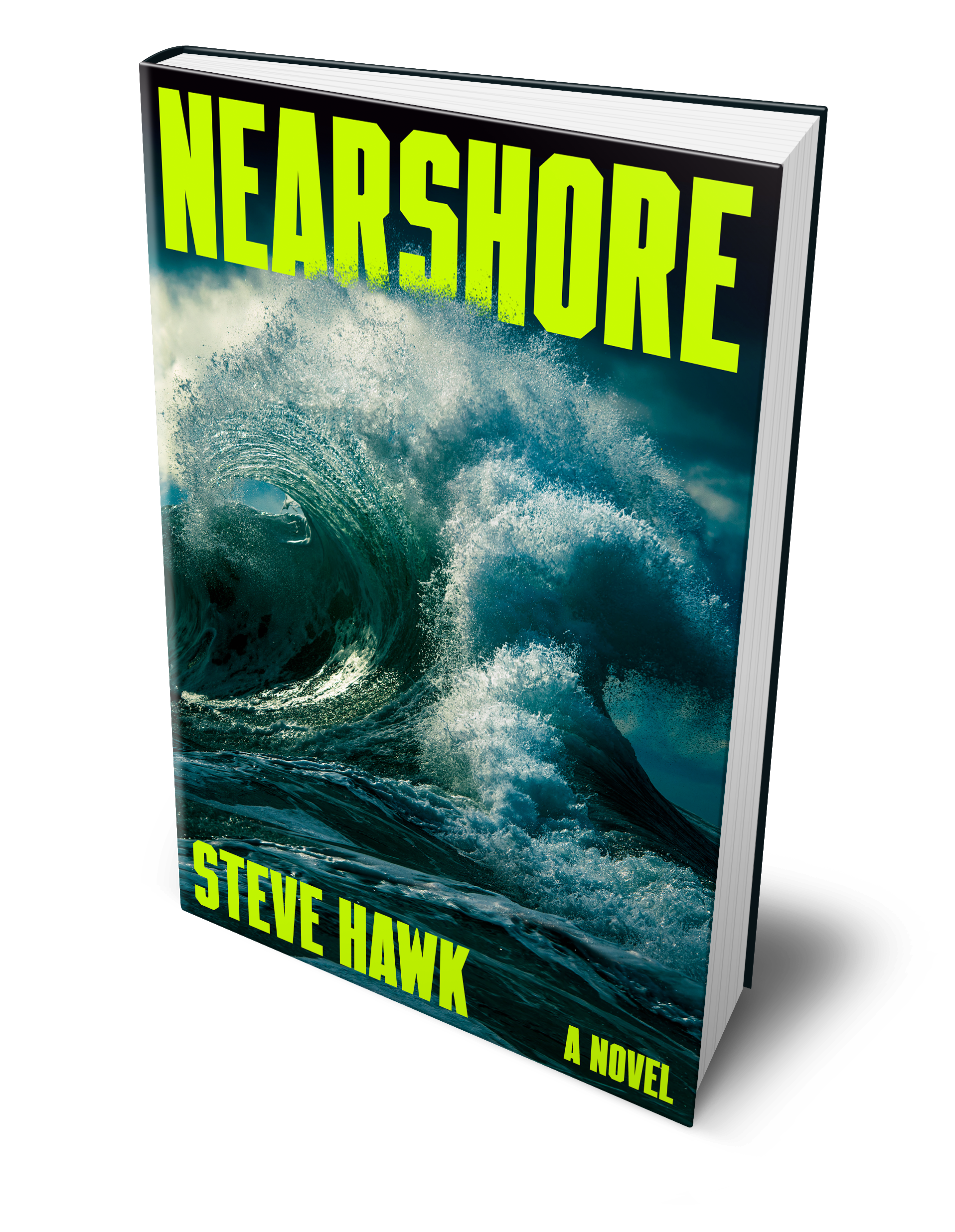
Daybreak. West Virginia. A “small” nuclear bomb detonates beside an Appalachian highway. The weapon’s explosive yield is meager, the death count blessedly low. And yet: It is history’s first act of nuclear terrorism, and it threatens to tilt the world beyond reckoning.
Months later, surfer and lifeguard Jamie Palmer is patrolling his domain, a treacherous stretch of wild California coast, when he responds to a mysterious nearshore boating accident that jettisoned two people overboard. The victims turn out to be Palmer’s best friend—a brilliant, renegade Stanford University professor—and the man’s teenage son, Luca. The professor drowns, Luca survives—leaving Palmer as the boy’s guardian.
Soon after, Chelsea Wu, a math prodigy and doctoral student, confides to Palmer that she and the professor unearthed a link between a Silicon Valley megacorporation, its sociopathic billionaire founder, and the nuke in West Virginia. When a second device is detonated, this unlikely team—the surfer, the orphan, and the math whiz—must persuade investigators that the bombmakers are not only homegrown but also hiding in plain sight.
An immersive and disturbingly plausible debut, Nearshore delivers a mix of literary suspense and coastal noir. Moving with the speed of a barreling wave, Nearshore also explores deeper clashes: isolation versus community and family, Silicon Valley versus humanity, words versus action, land versus sea.
Praise for Nearshore.
-
“NEARSHORE is the best novel of homegrown nuclear terrorism yet written, chillingly credible, terrifying, and all too plausible. I lived for twenty years in Northern California exactly where the story is set, and I’m very glad I moved.”
— Richard Rhodes, Pulitzer Prize-winning author of The Making of the Atomic Bomb
-
“Pure fun from start to finish. As someone who studies nuclear proliferation for a living, I can confirm: This scenario is the real deal, and the bad-guy billionaire is entirely plausible. Terrifying and thrilling in equal measure. Read it.”
— Jeffrey Lewis, Distinguished Scholar of Global Security at Middlebury College
-
“Engrossing, graceful, and transporting, this is a terrific—if terrifying—tale of near apocalypse.”
— Publisher’s Weekly
-
“A smart, fun, thrilling read. The characters pop and the story moves like a barreling full-speed point wave.”
— Matt Warshaw, author of The Encyclopedia of Surfing, The History of Surfing, and Mavericks: The Story of Big-Wave Surfing
-
“This is an exceptionally thoughtful literary thriller, beautifully rendered against the backdrop of a world its author very clearly knows and loves. In the depth and breadth of its story, in the lyricism of its prose, NEARSHORE will surely establish Steve Hawk as a writer to be reckoned with.”
— Kem Nunn, author of Tapping the Source, Dogs of Winter, and Tijuana Straits
-
“A polished and exhilarating first novel from a welcome new voice in literary suspense.”
— Booklist
-
“California surf culture has long run adjacent to big American tech, developing in the post nuclear era of the 1950s and flourishing in proximity to the state’s aerospace- and silicone-age industries in the decades thereafter. It has also, always, drawn on the iconography of the American West with its affinity for open space, wild beauty, and loner archetypes. In NEARSHORE, Steve Hawk assembles these contrasting elements and more, focuses them through the lens of a contemporary setting, attaches the fuse of a thriller, and builds a story in the traditions of Cormac McCarthy, Robert Stone, and Kem Nunn to deliver a novel that radiates outward with the speed and force of an atomic blast.”
— Alex Wilson, editor of The Surfer’s Journal
Nearshore sources.
SURF STUFF:
Waves and Beaches, The Powerful Dynamics of Sea and Coast, by Willard Bascom and Kim McCoy. An updated and beautifully illustrated version of the 1964 classic, from Patagonia Books.
Nearshore’s cover photo was taken by the prolific Australian photographer Ray Collins, who swims out in dangerous conditions to capture jaw-dropping images of beautiful, terrifying waves.
Alaska: The Land Duke Forgot, by Dave Parmenter, which ran in the January 1993 edition of Surfer magazine, is groundbreaking, lyrical, hilarious, and one of the best surf-adventure articles ever written. It’s not available online, but it can be found in three separate surf-story collections, all out of print: The Best American Sports Writing 1994, edited by Tom Boswell and Glenn Stout; Big Wave: Stories of Riding the World’s Wildest Water, by Clint Willis; and Zero Break: An Illustrated Collection of Surf Writing, 1777-2004, by Matt Warshaw.
The wave that Alo Slebir rode at Mavericks on Dec. 23, 2024 (which gets a nod in Nearshore), might be the most powerful wave ever ridden, even if it’s not the tallest.
NUKE STUFF:
Alex Wellerstein is the historian and author to follow if you want to nerd out about the history (and current risk) of nuclear weaponry. His “Doomsday Machines” newsletter continuously unearths twisted, funny, horrifying factoids and documents regarding the Manhattan Project, the idea of mutually assured destruction, and more. His NUKEMAP app, in which you get to pick a city and a bomb size and then measure the death toll, has been used by visitors to simulate almost 400 million “detonations.” It will scare you to your bones.
The Making of the Atomic Bomb, by Richard Rhodes, is the definitive, Pulitzer Prize–winning history of the Manhattan Project and its world-changing product.
The 2020 Commission Report on the North Korean Nuclear Attacks Against the United States, by Jeffrey Lewis, is a “speculative novel,” written with wry bureaucratic sobriety, about a devastating nuclear strike on America. The scariest part is that the triggering incident is a moronic, menacing tweet from our commander in chief.
Atom Bombs: The Top Secret Inside Story of Little Boy and Fat Man, by John Coster-Mullen. A shockingly detailed self-published book about the inner workings of the first atomic bombs, written by a former truck driver.
The Nonproliferation Emperor Has No Clothes: The Gas Centrifuge, Supply-Side Controls, and the Future of Nuclear Proliferation, by R. Scott Kemp. An MIT professor and expert on nuclear proliferation, Kemp has written extensively about the dangers of the world’s increasingly efficient uranium-enrichment industry.
Dan Lin’s video of Kathy Jetnil-Kijiner’s spoken-word poem, Anointed, about American nuclear tests in the Marshall Islands, is a masterpiece of political artistry.
Hiroshima, by John Hersey, is the best book ever written about the ghastly effects of history’s first nuclear attack.